

Functional Medicine
Healing That Starts With Understanding Your Unique Biology
Functional medicine is an evolution in the practice of healthcare that better addresses the healthcare needs of the 21st century.
Functional Medicine
Healing That Starts With Understanding Your Unique Biology
Functional medicine is an evolution in the practice of wellness that better addresses the healthcare needs of the 21st century.
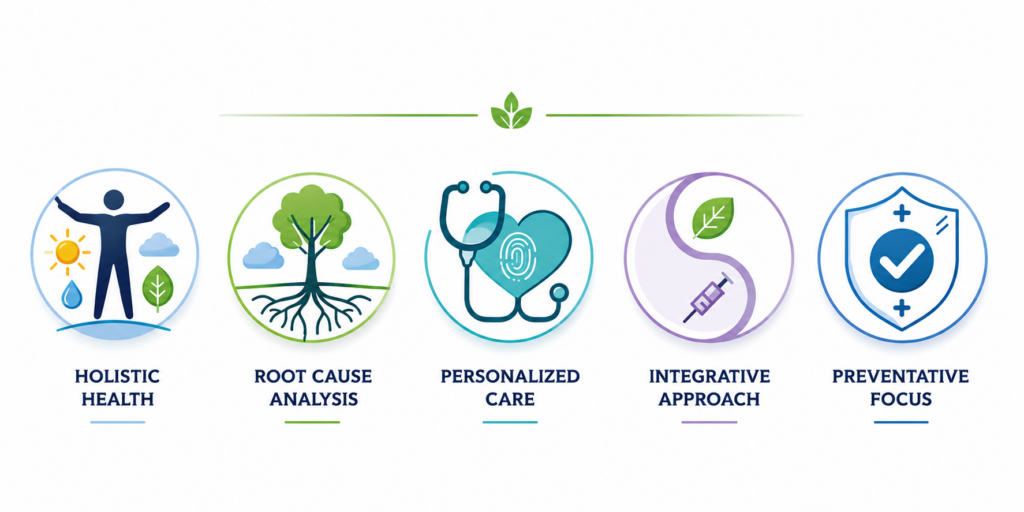
By shifting the traditional disease-centered focus of medical practice to a more “patient- centered” approach, functional medicine addresses the whole person, not just an isolated set of symptoms.
Functional medicine practitioners spend time with their patients, listening to their histories and looking at the interactions among genetic, environmental, and lifestyle factors that can influence long-term health and complex, chronic disease.
In this way, functional medicine supports the unique expression of health and vitality for each individual.
Why We Need
Functional Medicine?
Rising Rates of Chronic Disease
More people than ever are living with complex, long-term conditions like diabetes, heart disease, cancer, autoimmune disorders, and mental health challenges. These illnesses often develop over time and are driven by interconnected factors — genetics, nutrition, environment, and lifestyle.
The Limits of Conventional Medicine
Traditional medicine is built for acute care — diagnosing and treating emergencies such as infections, injuries, or sudden illness. While effective in crisis situations, it focuses on symptom management and short-term solutions, not the underlying causes of chronic disease.
Treating the Root Cause, Not Just the Symptoms
Functional Medicine looks deeper to uncover the “why” behind illness. By addressing root causes — rather than masking symptoms — it helps the body restore balance naturally through personalized, evidence-based care.
Bridging the Gap Between Research and Practice
There’s often a decades-long delay between emerging medical research and its use in clinical practice. Functional Medicine closes this gap by integrating the latest scientific findings into real-world, patient-centered care.
A Personalized, Preventive Approach
Each person’s biology, environment, and lifestyle are unique. Functional Medicine tailors treatment plans to those individual needs, empowering patients to take an active role in their healing through nutrition, movement, stress management, and lifestyle changes.
Why We Need Functional Medicine?
Rising Rates of Chronic Disease
More people than ever are living with complex, long-term conditions like diabetes, heart disease, cancer, autoimmune disorders, and mental health challenges. These illnesses often develop over time and are driven by interconnected factors — genetics, nutrition, environment, and lifestyle.
The Limits of Conventional Medicine
Traditional medicine is built for acute care — diagnosing and treating emergencies such as infections, injuries, or sudden illness. While effective in crisis situations, it focuses on symptom management and short-term solutions, not the underlying causes of chronic disease.
Treating the Root Cause, Not Just the Symptoms
Functional Medicine looks deeper to uncover the “why” behind illness. By addressing root causes — rather than masking symptoms — it helps the body restore balance naturally through personalized, evidence-based care.
Bridging the Gap Between Research and Practice
There’s often a decades-long delay between emerging medical research and its use in clinical practice. Functional Medicine closes this gap by integrating the latest scientific findings into real-world, patient-centered care.
A Personalized, Preventive Approach
Each person’s biology, environment, and lifestyle are unique. Functional Medicine tailors treatment plans to those individual needs, empowering patients to take an active role in their healing through nutrition, movement, stress management, and lifestyle changes.
The Root Cause | How is Functional Medicine Different?
Functional medicine involves understanding the origins, prevention, and treatment of complex, chronic disease. Hallmarks of a functional medicine approach include:
Patient-centered care:
The focus of functional medicine is on patient-centered care, promoting health and vitality, beyond just the absence of disease. By listening to the patient and learning his or her story, the practitioner brings the patient into the discovery process and tailors treatments that address the individual’s unique needs.
An integrative, science-based healthcare approach:
Functional medicine practitioners look “upstream” to consider the complex web of interactions in the patient’s history, physiology, and lifestyle that can lead to illness. The unique genetic makeup of each patient is considered, along with both internal (mind, body and spirit) and external (physical and social environment) factors that affect total functioning.
Integrating best medical practices:
Functional medicine integrates traditional Western medical practices such with what are sometimes considered “alternative” or “integrative” health approaches, creating a focus on prevention through nutrition, diet, and exercise; use of the latest laboratory testing and other diagnostic techniques; and prescribed combinations of Chinese Herbal & botanical medicines, nutritional supplements, therapeutic diets, courses of acupuncture treatment, lifestyle modifications and stress-management techniques.
The Functional Medicine Approach to Assessment
Environmental inputs:
The air you breathe and the water you drink, the particular diet you eat, the quality of the food available to you, your level of physical exercise, and toxic exposures or traumas you have experienced, all affect your health.
Mind-body elements:
Psychological, spiritual, and social factors all can have a profound influence on your health. Considering these areas helps the functional medicine practitioner see your health in the context of you as a whole person, not just your physical symptoms.
Genetic makeup:
Although individual genes may make you more susceptible to some diseases, your DNA is not an unchanging blueprint for your life. Emerging research shows that your genes may be influenced by everything in your environment, as well as your experiences, attitudes, and beliefs. That means it is possible to change the way genes are activated and expressed.

Through assessment of these underlying causes and triggers of dysfunction, the functional medicine practitioner is able to understand how key processes and larger biological functions are affected such as:
- How your body rids itself of toxins
- Regulation of hormones and neurotransmitters
- Immune system function
- Inflammatory responses
- Digestion and absorption of nutrients and the health of the digestive tract
- Structural integrity
- Psychological and spiritual equilibrium
- How you produce energy
When these bodily functions are disturbed or imbalanced, they lead to symptoms, which can lead to disease if effective interventions are not applied.
Treating the Whole Person, Not Just Symptoms
The goal of functional medicine is prevention and addressing the underlying clinical imbalances that may lead to any number of chronic illnesses.
The human body functions as a network of interconnected systems that affect each other, so functional medicine treats the whole body rather than a sub-section or single organ system.
And because each body is unique, functional medicine considers each patient’s “biochemical individuality”—those variations in optimal body functions due to genetic or lifestyle factors.
A Comprehensive Approach to Treatment
The patient becomes a partner:
Prevention is paramount:
Changing how the systems function can have a major impact on the patient’s health:
Testimonials
Patient Stories of Transformation
Women’s Wellness Insights
Welcome to our Blog!
Explore supportive education and fresh perspectives on fertility, hormonal balance, menstrual and monthly cycle health, peri-menopause and menopause, thyroid health, and autoimmunity. Discover functional medicine insights, practical lifestyle wellness practices and evidence-informed nutrition strategies to help you thrive through every stage of womanhood.

Hello world!
Welcome to WordPress. This is your first post. Edit or delete it, then start writing!
